


Bond Investing
When you buy a bond, you’re lending money to a company, municipality, or government in exchange for regular interest payments over a set period (the bond’s term). When the bond matures, you are repaid the amount you lent, known as the par value or principal. With bonds, you’re not owning companies (like with stocks); you’re lending money to them. So, a bond is a loan.
For example, a typical bond might have a $1,000 principal value and pay 5% annual interest. That means you receive $50 per year, usually paid in two $25 installments. When the bond matures, you get your $1,000 back, plus your final interest payment, assuming the borrower can make the payment as agreed.
As bond investors, our job is to evaluate the likelihood that each borrower, whether that’s a company, municipality, or the federal government, will repay its obligations. We want to identify the bonds with the highest potential return relative to the risk of lending our money.
Bonds are generally considered “safer” than stocks. Why? They provide contractual (and predictable) interest payments and are legally prioritized over stock if the lender faces financial difficulties. Historically, bonds have generally produced lower long-term returns than stocks; however, you’re still earning an investment return, and that range of return outcomes is much narrower for the reasons mentioned above.
There are three main types of bonds:
- Corporate bonds are issued by companies and grouped by credit rating, an independent measure of a borrower’s ability to repay its debts. Bonds with strong ratings are considered investment-grade, while high-yield (or “junk”) bonds carry more risk but offer higher interest rates.
- Municipal bonds, or “munis,” are issued by states, cities, counties, and other local government entities.
- U.S. Treasury bonds are backed by the full faith and credit of the federal government.
We invest across all three types to help balance growth and stability within our portfolio.
There are many different types of bonds, but evaluating them generally comes down to two main questions:
- How much risk are we willing to take on the borrowers we lend to? The fancy word for this is “credit risk,” and higher credit risk just means you lend to riskier borrowers (presumably at a higher interest rate).
- How long should we lend money for? Shorter-term loans make sense if we’re concerned about a borrower’s ability to repay. Or, if we expect interest rates to rise. In that latter case, we’d want our loans to mature sooner so we can reinvest at higher rates. Conversely, if we expect rates to fall, it’s better to “lock in” current rates for longer to continue earning more. Most investors call this “interest rate risk.”
Both of these risks (credit and interest rate) are shown in the graph below. We move around inside this box depending on the opportunities we see in the market.
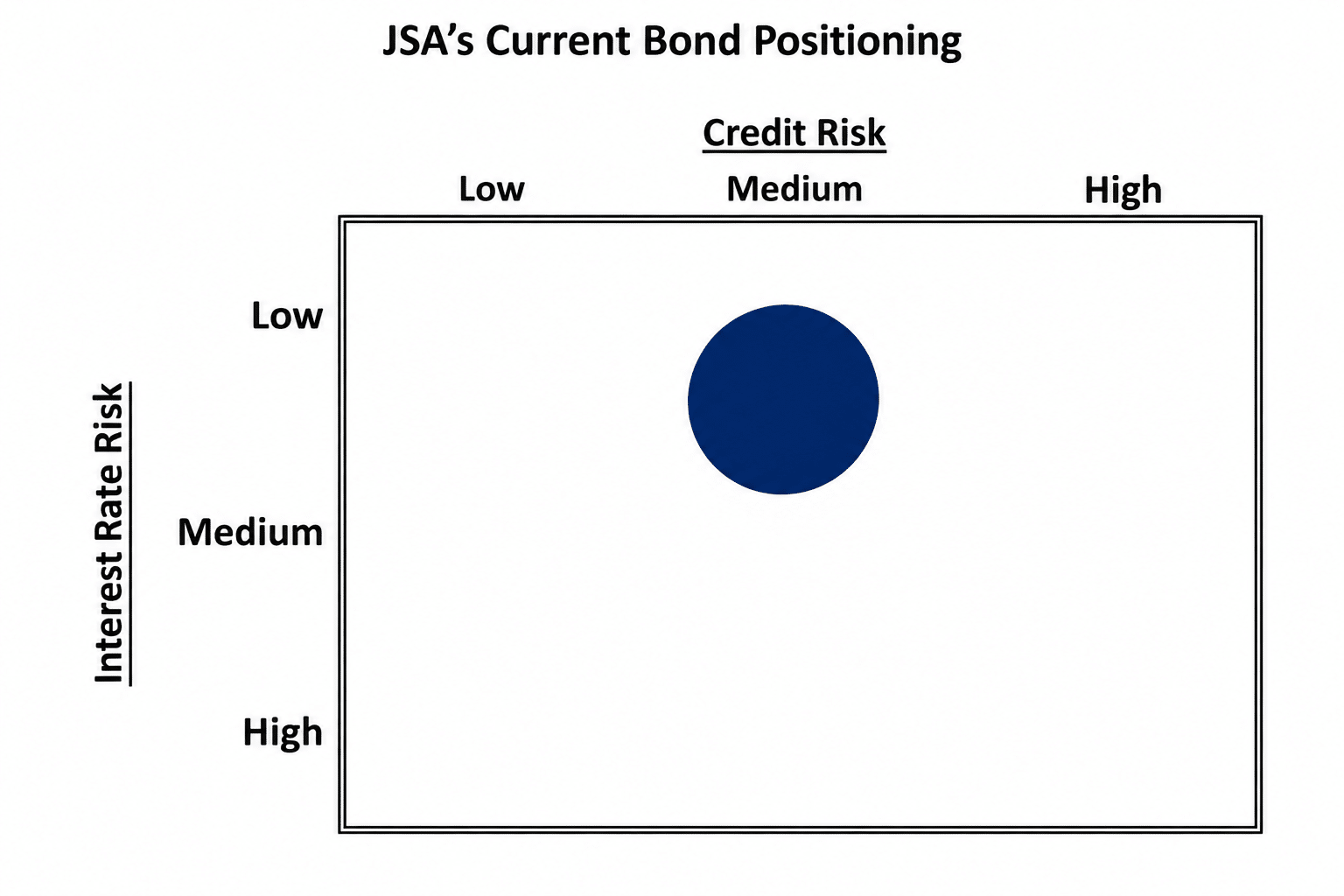
Bond portfolios can be adjusted over time as market conditions and investment opportunities change.
For example, two areas that have recently received increased attention include:
- Mortgages. We believe that investing in residential mortgages (loans provided to borrowers for their primary homes) offers a good investment return. A unique aspect of these loans is that they are pooled by government entities that guarantee the timely payment of principal and interest to us, even if the borrowing homeowners can’t repay their loans. This makes them a lower risk than most loans, and they offer a good return at present.
- Floating Rate Loans. Here, we’ve invested in loans to companies and the U.S. government, whose interest payments rise and fall with current interest rates. These loans provide a very stable part of the bond portfolio, so they tend to hold their value even during crazy moves up or down in the market.
At JSA, we’ll move the bond portfolio around as we see opportunity, just like we do with investing in companies. However, it’s a different goal or way of thinking: getting back the money we lend (bonds) versus participating in the long-term growth of a business (stocks).
In summary, bonds can provide interest income and may play an important role in managing portfolio volatility and providing liquidity. The role bonds play in a portfolio, and the types of bonds selected, can vary based on an investor’s goals, time horizon, risk tolerance, and market conditions. At JSA, we evaluate these factors and adjust the bond portfolios we manage as market opportunities change.
If you’re ready to explore adding bonds to your investment portfolio, or want to learn more, contact us! We’d love to hear from you. https://jandsadvisors.com/contact-us/


